
Short answer: A typical dryer vent replacement runs about $600 to $1,100 with Mansfield Services in northern Vermont. The range is wide because setups vary a lot: a short, straight run out an exterior wall is at the low end, while long runs through finished walls, ceilings, attics or the roof cost more. Replace the vent when the duct is plastic or foil, crushed, disconnected, too long, or doesn’t end outside. If the duct itself is sound, a cleaning is usually all it needs.
How much does dryer vent replacement cost?
For a typical setup, dryer vent replacements run about $600 to $1,100. Every house is laid out differently, so the only way to pin down an exact price is to look at the whole run, from the back of the dryer to where it exits the house.
You’ll see lower numbers online, often $140 to $600. Most of that pricing comes from lead-generation sites that make their money selling homeowner requests to contractors. Their ranges lean on small jobs, like swapping the hose behind the dryer, and on entry-level pricing from newer contractors trying to win work, so they don’t reflect what an established, insured company charges. A full replacement means removing the old duct, running new smooth metal duct, and installing a new exterior hood, and for a typical setup that comes to about $600 to $1,100.
What moves the price up or down
| Factor | Lower end | Higher end |
|---|---|---|
| Length of the run | A few feet to the outside wall | Long runs close to the 35-foot limit |
| Bends | One or two elbows | Several elbows |
| Route | Exposed in a basement or laundry room | Inside finished walls, ceilings or an attic |
| Where it exits | Exterior wall | Roof |
| Exterior | Vinyl or wood siding | Brick, stone or stucco |
Do you need to replace your dryer vent, or just clean it?
We’ve cleaned more than 1,100 dryer vents across northern Vermont, and most only need a cleaning. Replacement makes sense when the duct itself is the problem.
| What you have | Cleaning is enough | Replace or reroute |
|---|---|---|
| Duct material | Smooth rigid metal in the walls, in good shape | Plastic, vinyl, foil or semi-rigid duct run inside walls or ceilings |
| Condition | Intact, connected, not crushed | Crushed, kinked, torn, pulled apart at a joint, or rusted through |
| Length and bends | Under 35 feet after taking off 5 feet per 90° and 2½ feet per 45° | Over the limit, or too many bends |
| Where it ends | Outside, with a working flap | In the attic, crawlspace, garage or inside a wall, or behind a screen |
| After a cleaning | Clothes dry normally again | Still slow, which usually points to the duct layout |
Not sure which one you have? Our dryer vent cleaning is camera-inspected end to end, so you’ll see the condition of the whole line before deciding anything.
Signs your dryer vent needs replacing
- Clothes are still damp after a normal cycle, or drying takes longer than it used to.
- There’s little or no airflow at the outside vent while the dryer runs.
- The laundry room gets hot, or clothes come out hot and musty.
- You can see white vinyl or foil accordion duct behind the dryer or in the basement.
- The duct is crushed behind the dryer, sagging, or pulled apart at a joint.
- The outside flap is stuck or broken, or the hood has a screen on it.
- The vent ends in the attic, a crawlspace or the garage instead of outside.
The U.S. Consumer Product Safety Commission recommends replacing plastic or foil accordion duct with metal, because the accordion type traps lint more easily and kinks or crushes. Inside walls and ceilings, the code goes further and requires smooth rigid metal; semi-rigid duct is only for the short connector behind the dryer.
It matters for safety. The National Fire Protection Association estimated 15,970 home fires a year involving clothes dryers or washing machines in 2010–2014, with 13 deaths, 440 injuries and $238 million in property damage on average. Dryers were involved in 92% of those fires, and failure to clean was the leading factor, at 31%.
What material should a dryer vent be?
| Type | Where it belongs | Lint and crushing | Verdict |
|---|---|---|---|
| Rigid metal, 4-inch, smooth inside | The duct in walls, ceilings and long runs | Holds the least lint and won’t crush | The standard for the duct itself |
| Semi-rigid aluminum | The short connection behind the dryer | Ridged inside and can dent | Only as the connector behind the dryer, if it’s listed; never inside a wall |
| Foil accordion | Behind the dryer only, if it’s listed | Ribs catch lint and it crushes easily | Never inside a wall; CPSC recommends replacing it |
| Plastic or vinyl | Nowhere | Traps lint | Replace it; the code requires metal |
Transition hose vs. dryer duct: what goes behind the dryer?
They’re two different parts. The transition duct is the short connector from the back of the dryer to the vent in the wall. Under the International Residential Code (IRC), it has to be a single piece, listed and labeled to UL 2158A, no longer than 8 feet, and never hidden inside a wall, floor or ceiling.
Everything past that is the exhaust duct. It has to be smooth-walled metal at least 0.0157 inch thick (28 gauge) and 4 inches in diameter.
How long can a dryer vent be?
35 feet total, minus 5 feet for every 90° bend and 2½ feet for every 45° bend. That’s the International Residential Code limit, measured from the connector behind the dryer to where the vent exits outside. The connector itself doesn’t count.
Example: two 90° bends and one 45° bend take off 12½ feet, so the straight duct can be up to 22½ feet.
The dryer manufacturer’s installation instructions can allow a different length, and the code accepts that. A dryer exhaust power ventilator listed to UL 705 can also extend a run, but booster fans aren’t allowed. Any run longer than 35 feet equivalent needs a permanent label within 6 feet of the dryer connection showing its length.
Roof vent or wall vent?
When the layout allows it, a wall exit is usually the better choice: it’s shorter, easier to reach, and easier to keep clean. Roof vents have to push warm, damp air up and out, the cap can pack with lint, and the damper is hard to check. In cold climates, warm exhaust can also melt snow on the roof that refreezes at the edge, adding to ice dams.
We only run a dryer vent through the roof when it’s the only practical route and the roof is safe to work on. Whenever an outside wall can be reached, that’s the way we go.
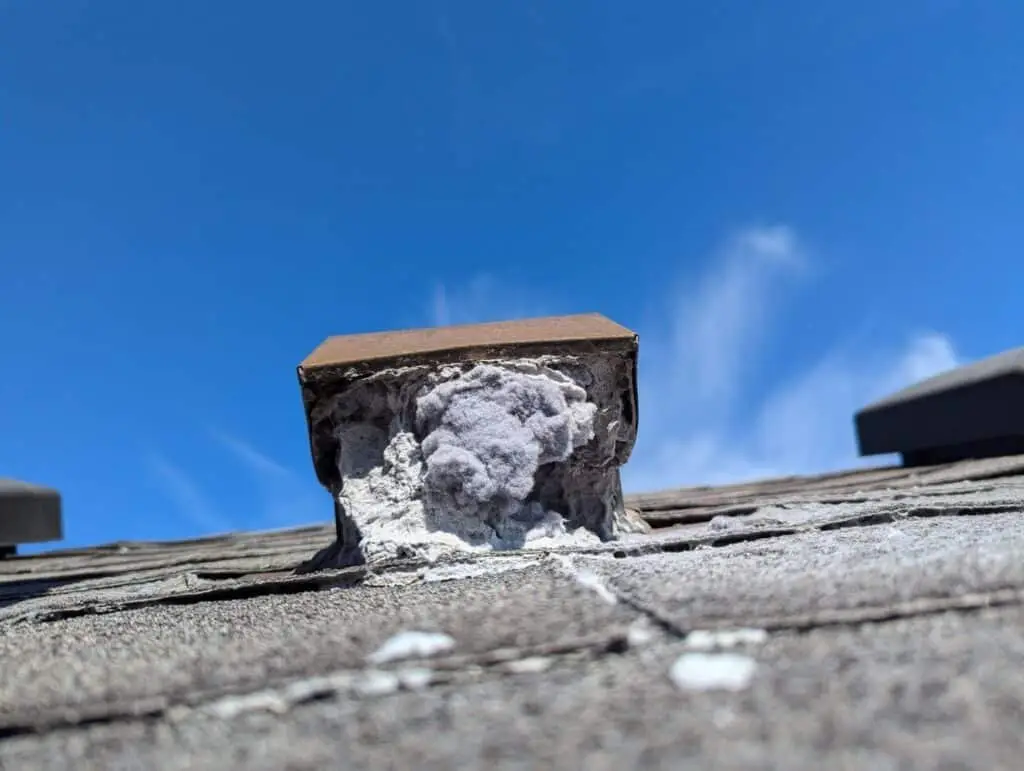
Either way, the vent has to end outside the house with a backdraft damper and no screen, at least 3 feet from doors, windows and other openings unless the dryer manufacturer says otherwise.
What a proper dryer vent replacement includes
- 4-inch smooth metal duct, at least 0.0157 inch (28 gauge) thick.
- No screws or fasteners sticking more than 1/8 inch into the duct, since anything that sticks in catches lint.
- Support at least every 12 feet.
- A transition duct listed to UL 2158A, 8 feet or shorter, left out in the open.
- An exterior hood with a backdraft damper and no screen.
Dryer vent hose: size, tight spaces, and when to replace it
The hose behind the dryer (the transition duct) should be 4 inches, the same size as the dryer outlet and the duct in the wall. Whatever you use, it needs to be listed and labeled to UL 2158A, 8 feet or shorter, and out in the open.
There’s no set schedule for replacing the hose. Replace it any time it’s crushed, kinked, torn, plastic, or an unlisted foil type, and check it every time the vent is cleaned.
Replacing just the outside dryer vent cover
Often the only failed part is the hood on the outside of the house: flaps crack or fall off, louvers stick, and birds or lint block the opening. If the duct behind it is sound, replacing the cover is a much smaller job than a full replacement.
A replacement cover should have a backdraft damper that closes when the dryer is off, no screen, and a full-size opening (at least 12.5 square inches of open area under the IRC). If the old cover had a screen, or the flap stays open, lint is usually the reason.
Can you replace a dryer vent yourself?
Swapping the connector behind the dryer is a reasonable do-it-yourself job: buy a transition duct listed to UL 2158A, keep it short and as straight as possible, and don’t push the dryer back hard enough to crush it.
Replacing the duct inside walls or ceilings, cutting a new opening in the siding, or rerouting a roof vent is a different job. It means working inside walls or ceilings, sealing every joint, and keeping fasteners out of the airflow.
How long does a dryer vent replacement take?
National cost guides put a standard installation at about 2 to 4 hours of labor. Long runs inside finished walls or ceilings, or moving a vent from the roof to a wall, take longer.
Dryer vent replacement near you in Vermont
Mansfield Services is based in Underhill and handles dryer vent cleaning and replacement across Chittenden, Lamoille and Franklin counties, including Burlington, South Burlington, Essex, Essex Junction, Williston, Colchester, Shelburne, Jericho, Underhill, Milton and Stowe.
Frequently asked questions
How much does it cost to replace a dryer vent in Vermont?
With Mansfield Services, a typical dryer vent replacement runs about $600 to $1,100. Short, straight runs out an exterior wall are at the low end; long runs inside finished walls or ceilings and roof exits cost more.
Is foil dryer duct against code?
Foil accordion duct can’t be used as the exhaust duct inside walls or ceilings, because the code requires smooth metal there. A foil connector is only allowed as the short transition behind the dryer if it’s listed and labeled to UL 2158A, 8 feet or shorter, and not concealed. The CPSC recommends replacing plastic or foil accordion duct with metal.
Can a dryer vent go through the roof?
Yes, as long as it ends outside with a roof cap that has a backdraft damper and no screen, and the total length stays within limits. We only install roof vents when it’s the only practical route and the roof is safe to work on, since a wall exit is easier to keep clean.
Can I use screws on dryer duct?
The IRC doesn’t allow screws or other fasteners to stick more than 1/8 inch into the duct, because anything that sticks in catches lint.
Why can’t the outside dryer vent have a screen?
Screens catch lint and clog, which blocks the airflow. The IRC prohibits screens at the dryer vent exit. The hood should have a backdraft damper instead, which closes when the dryer is off.
Can a dryer vent end in the attic or garage?
No. Dryer exhaust has to go all the way outside. Venting into an attic, crawlspace or garage puts lint and moisture inside the house.
Do condensing or heat pump dryers need a vent?
No. Ventless condensing and heat pump dryers don’t use an exhaust duct, and listed ductless dryers are exempt from the dryer exhaust rules. Follow the manufacturer’s instructions for the condensate.
How often should a new dryer vent be cleaned?
Once a year is a good rule for most homes. Large households or heavy dryer use can call for cleanings more often.
Can a dryer vent be PVC?
No. PVC and other plastic pipe can’t be used for dryer exhaust. The IRC requires the exhaust duct to be smooth metal, and plastic traps lint and isn’t made for dryer heat.
Can a dryer vent run up?
Yes. A dryer vent can run vertically, including up through an attic to the roof, as long as it ends outside and the total length, counting every elbow, stays within 35 feet or the limit in the dryer manufacturer’s instructions.
How often should you replace a dryer vent hose?
There’s no set schedule. Replace the hose any time it’s crushed, kinked, torn, plastic, or an unlisted foil type, and check it every time the vent is cleaned.
Can you replace just the outside dryer vent cover?
Yes. If the duct behind it is in good shape, a broken flap or clogged cover can be replaced on its own. The new cover should have a backdraft damper, no screen, and a full-size opening.
Not sure if your dryer vent needs replacing?
Start with a dryer vent cleaning. It’s camera-inspected end to end, so you’ll know whether the duct is worth keeping. We serve Chittenden, Lamoille and Franklin counties. Call or text (802) 777-3210.
Book now → See dryer vent cleaning →Related guides
- How often should you clean your dryer vent?
- Signs your dryer vent is clogged
- Why is the “Check Vent” light on?
- Cleaning your dryer vent yourself vs. hiring a pro
- Dryer vent smells, birds and animals
- How much dryer vent cleaning costs
- Roof-vented dryers in Vermont
Sources
- International Residential Code (2021), Section M1502: Clothes Dryer Exhaust
- U.S. Consumer Product Safety Commission: Overheated Clothes Dryers Can Cause Fires
- NFPA: Home Fires Involving Clothes Dryers and Washing Machines (fact sheet, 2017)
- Angi: How Much Does It Cost to Install or Replace a Dryer Vent?
- HomeAdvisor: Dryer Vent Installation Cost